MARKING POLICY
Last updated: January 6, 2002
This document is posted as an aid in interpreting the marks assigned to work
(assignments, tests, or examinations) in this course.
- Please remember that marks are not a judgment of your intelligence or
diligence or good intentions; they are just a reflection of the work you
handed in. If you were very busy with other work, or recuperating from an
illness, or emotionally stressed, it would be not be surprising if your mark
was lower than under optimal conditions. However, a reason cannot be used as
an excuse.
- If assignments and project are not handed in by the due date, then your
mark is a zero (once model solutions are
posted it is obvious that we cannot mark you assignment even with a medical
letter)..
- The numerical score (or "raw mark score") that you are given on
a unit is never to be interpreted as or converted to a percentage. Let us
call the mark you receive on a component your RRMS (ranking raw mark score).
Your RRMS, on a particular unit such as a test, is merely a way for me to
rank you amongst your peers. For example, an RRMS of 76/100 should not
necessarily be interpreted as a B+. It just means you did better than a
student who scored 75. Your RRMS is just there to rank you in the class.
Thus, I may feel that a 76 (in this case) is really a C+ and not a
B+.
- I assign letter grades to the RRMS on a basis which I feel is both fair,
looking at the marking unit, and reflects the meaning of each letter grade
as determined by the York Senate and published in the York Undergraduate
Programmes Calendar (p. 127). In the final analysis, it is the letter
grade only, that will have a meaning to you, with the RRMS merely the means
to calculate your final grade.
- After each marking unit, I publish via courseInfo a table of
conversions from the RRMS to the letter grade. Your letter grade can thus be
computed from your RRMS by looking it up in the table. For example, you may
obtain the conversions by invoking courseInfo 3311P if you're taking
cosc3311 section P.
- Claims that the marker overlooked an answer on a test or exam are usually
not accepted if the marker indicated that no answer was present (e.g. by
assigning a score of 0 to that question.)
Here is an example of how the raw marks are used in a course where there is
an assignment (20%), test (25%) and exam (55%). If your browser supports excel
spreadsheets, you can can look at the actual spreadsheet grades.xls
as well.
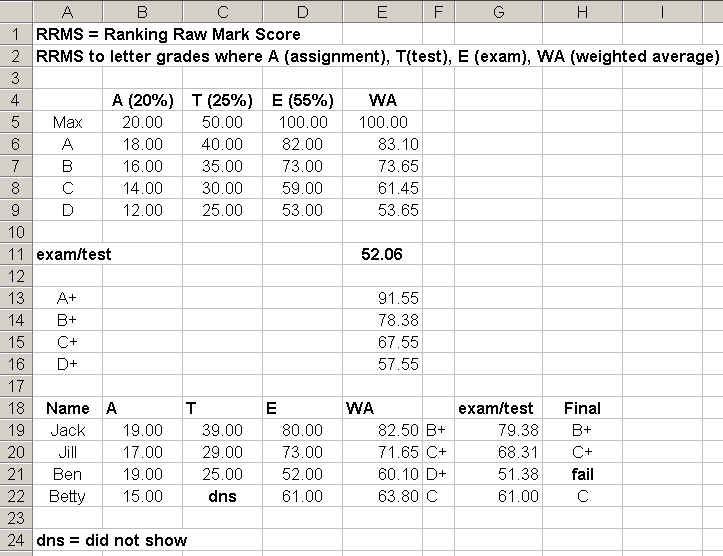
- After the assignment is marked and handed back, the conversion table will
be published as shown above. In this assignment, you need an RRMS of 18/20
to get an A. Note that Jill's 17 on the assignment is not an A.
In fact it is a B+.
- The conversion table will be published after each unit is marked and
handed back to you in class.
- Your knowledge of what you achieved on the individual units completely
determines your final grade. Once all the units (including the exam) have
been marked, we can compute the weighted average (WA) you need to
obtain the corresponding letter grade for the course. For example, to get an
A in this course, your weighted average must be at least 83.1. The
calculation for the WA for an A is:
WA(A) = =(0.2*(B6/B5)+0.25*(C6/C5)+0.55*(D6/D5))*100
- To get an A+ for the course, you need at least 91.55. This is the midpoint
between an A and the next letter grade (in this case the maximum mark) and
is calculated by:
WA(A+) = E6 + (E5-E6)/2
- Notice that Jack's final grade is a B+ because he did not quite make the A
breakpoint of 83.1. Jack's A+ on his assignment did not help him get an A
for his final grade.
- Ben achieved a WA of 60.1, i.e. a a D+. Nevertheless, Ben failed the
course. This is because Ben's weighted exam/test component was 51.38 whereas
52.06 was required. The 52.06 was calculated by:
=((0.25/0.8)*(C9/C5) +(0.55/0.8)*(D9/D5))*100
i.e. the test (.25) plus exam (.55) correspond to a weight of .8 together
(.25 + .55), and the test contributes .25 of this weight and the exam .55 of
this weight. The assignment is ignored in this calculation. Ben's weighted
test/exam component of 51.38 is calculated by:
=((0.25/0.8)*(C21/C5) +(0.55/0.8)*(D21/D5))*100
- Betty missed the test (dns). The weight of her exam must thus be
increased by the weight of her test, i.e. her exam now has .8 of the
total weight. Betty's WA of 63.8 is calculated by:
=(0.2*(B22/B5)+0.8*(D22/D5))*100
Her weighted test/exam component is calculated as =((0.8/0.8)*(D22/D5))*100.
In this case, it is of just whatever the exam mark is.